Yieldstreet connects investors with alternative assets, yet the mobile experience lagged behind the web platform. The objective of this project was to address the critical investor pain points to streamline portfolio management and on-the-go investment execution.
Key Results
72% boost in user engagement.
16% increase in mobile investment completion rate.
Reduced the startup load time from minutes to seconds.
Role & Timeline
Lead Product Designer and Research
March 2025 - June 2025
Methods
User Research / User Interviews / Competitive Analysis / Design Audit / Visual design / Prototyping / Testing


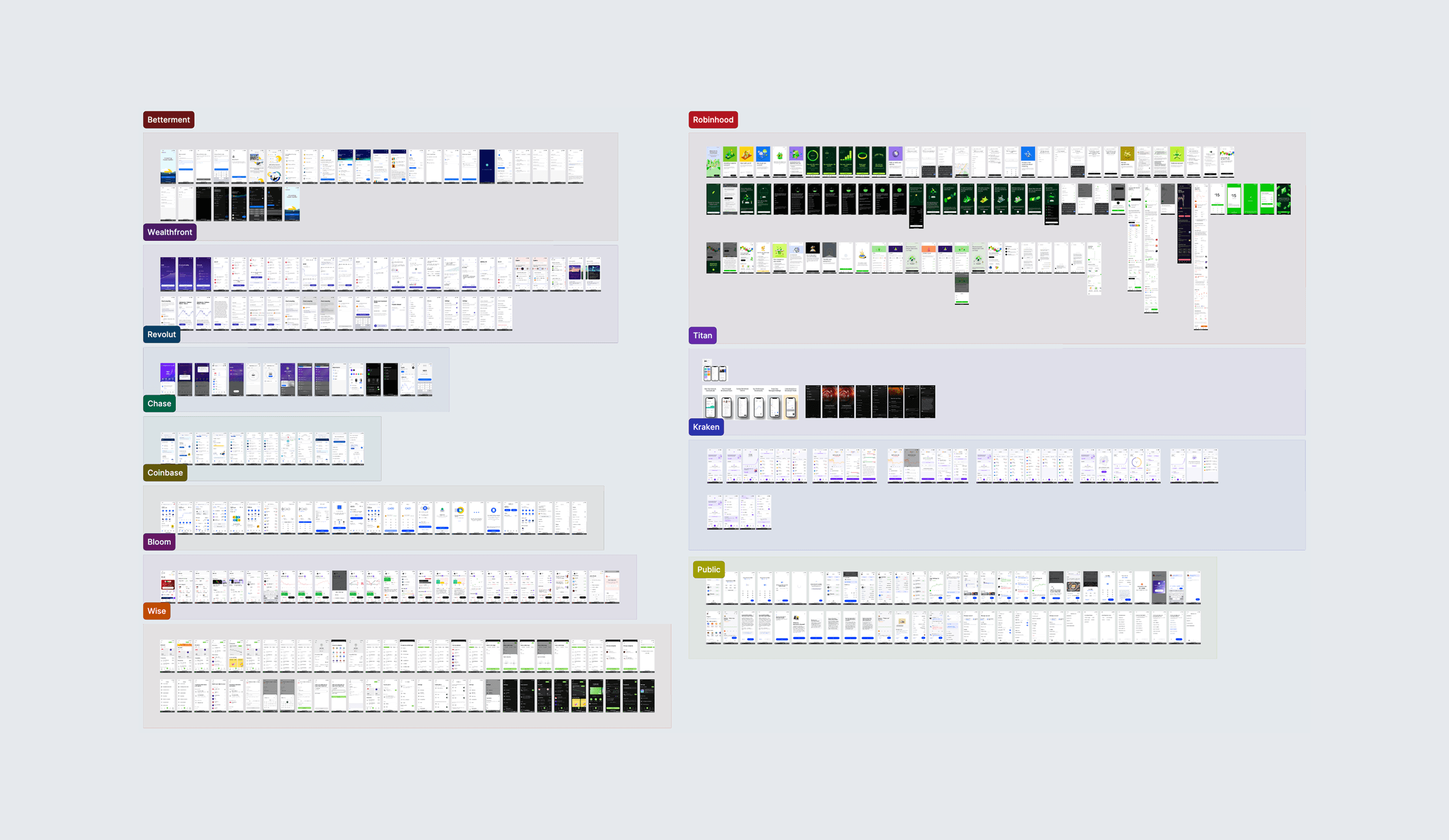
A study of popular fintech apps was conducted to identify strengths and weaknesses in the market. This analysis focused on three key areas: onboarding, dashboard presentation, and investment flows. Special attention was paid to how competitors handled complex data display on small screens while maintaining high user trust. The insights gained directly informed the Visual Direction and helped establish best practices for streamlined navigation and clear information hierarchy in the new design.
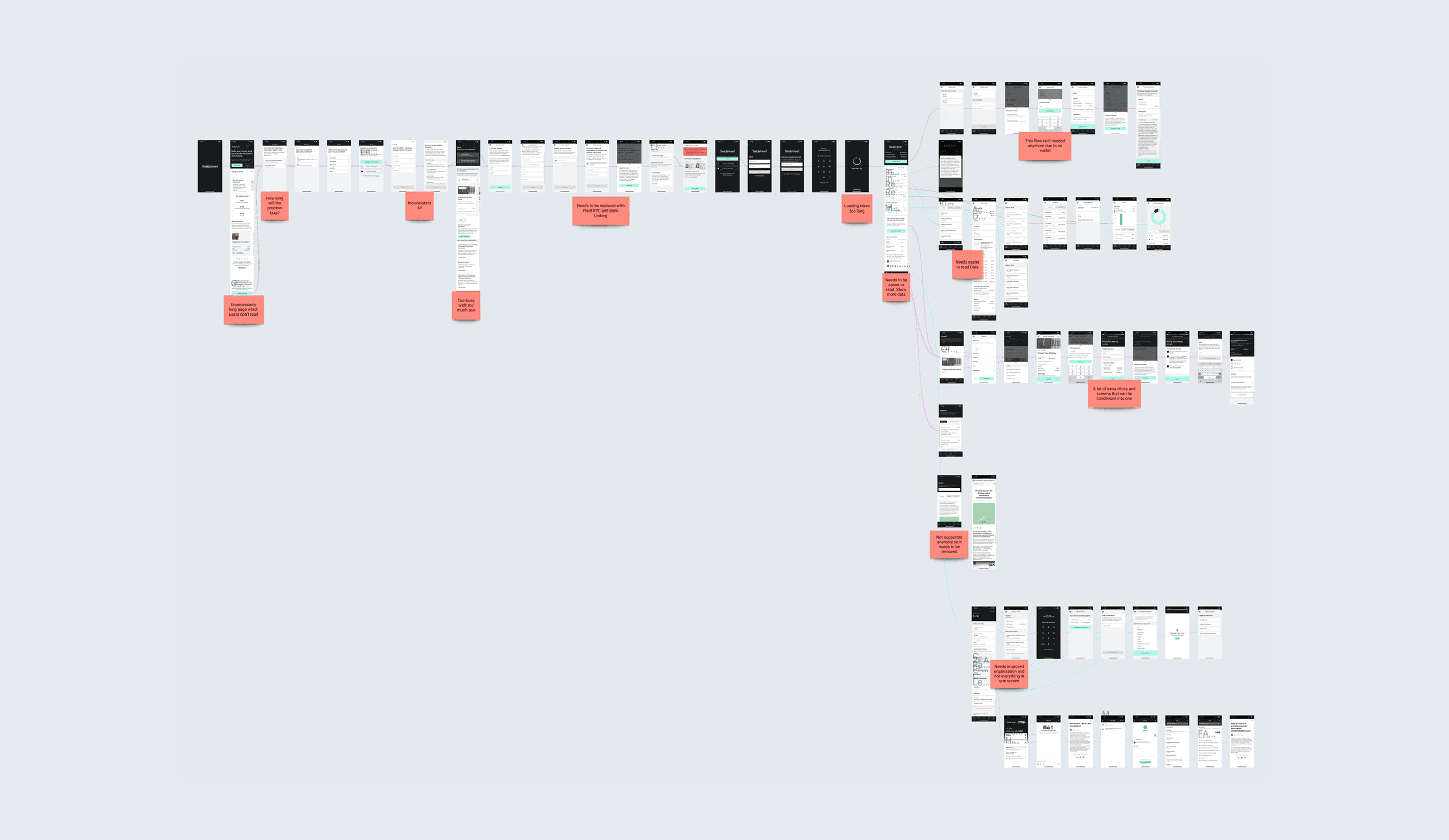
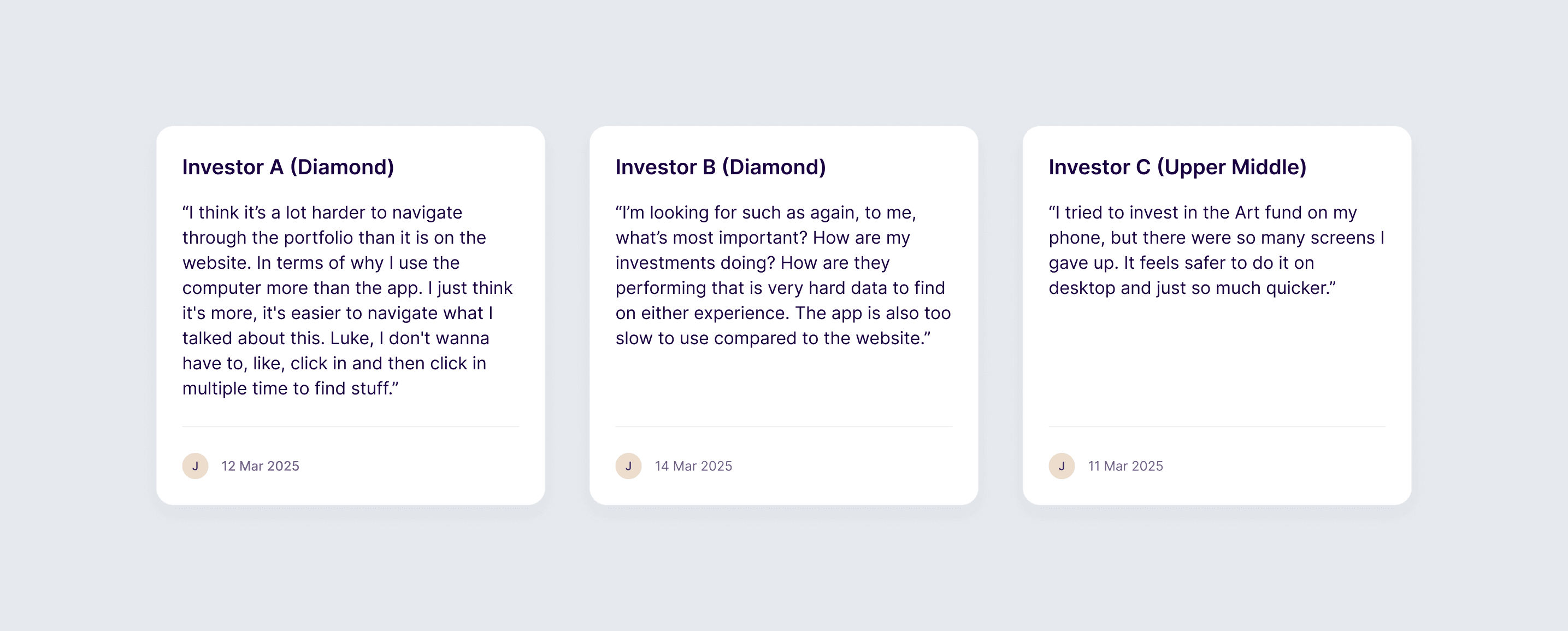
Considering these performance and usability issues, the aim was to re-architect the mobile app for superior speed and unify the design to match the web experience. By doing this, investors will be able to easily and quickly monitor their portfolio and complete investment transactions while on the go. Success is measured by an increase in monthly active user engagement and the mobile investment completion rate.
Project Goals & Success Metrics
The overall strategy focused on building a mobile platform that felt trustworthy, fast, and familiar, directly addressing the technical and experience gaps between the mobile app and the web experience.
The Primary Goal
Unify the mobile experience with the web platform through a technical overhaul, aiming to deliver a fast, trusted, and consistent user experience that makes on-the-go portfolio monitoring and investment completion seamless for investors.
To ensure a fast build and reliable performance, the engineering team selected React Native Paper (based on Material Design 3) as the technical foundation. The design challenge was to prevent the app from looking like a generic template while leveraging the speed of this library.
The base MD3 system was radically adapted to the Yieldstreet brand. This involved:
Theming: Overriding core tokens—typography, colour palettes, and corner roundness—to strictly align with the web aesthetic.
Custom Components: Designing and building bespoke components for complex financial data displays that the standard library didn't support.
Brand Alignment: Ensuring that while the code was React Native, the feel was unmistakably Yieldstreet.
This strategy allowed for a faster launch without sacrificing the unique brand identity.
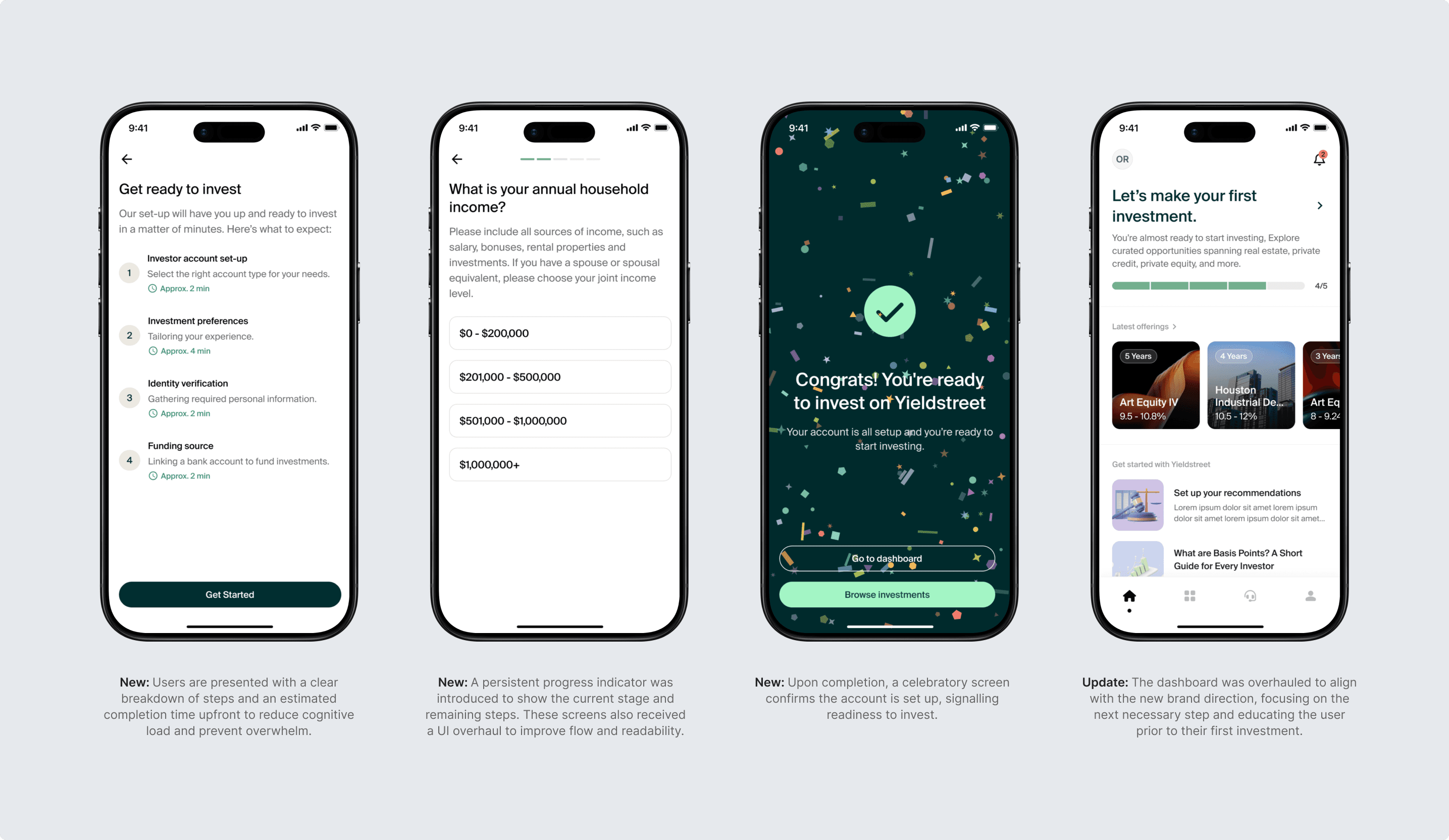
First impressions are critical for trust. The onboarding flow was overhauled to bridge the visual gap between the app and the web.
Setting Expectations: A clear breakdown of the account creation steps and an estimated completion time were added upfront to reduce user drop-off.
Visibility & Progress: For every section, a persistent step indicator was implemented at the top, giving users constant visibility into where they were in the process.
Improved Readability: Information density was optimised for mobile, breaking complex legal and personal queries into digestible, single-focus screens.
Post-signup Dashboard: The post-signup experience was refined to be more than just a placeholder. The improved design focuses heavily on education, offering bite-sized content on alternative assets and guiding users directly to make their first investment to build early confidence.
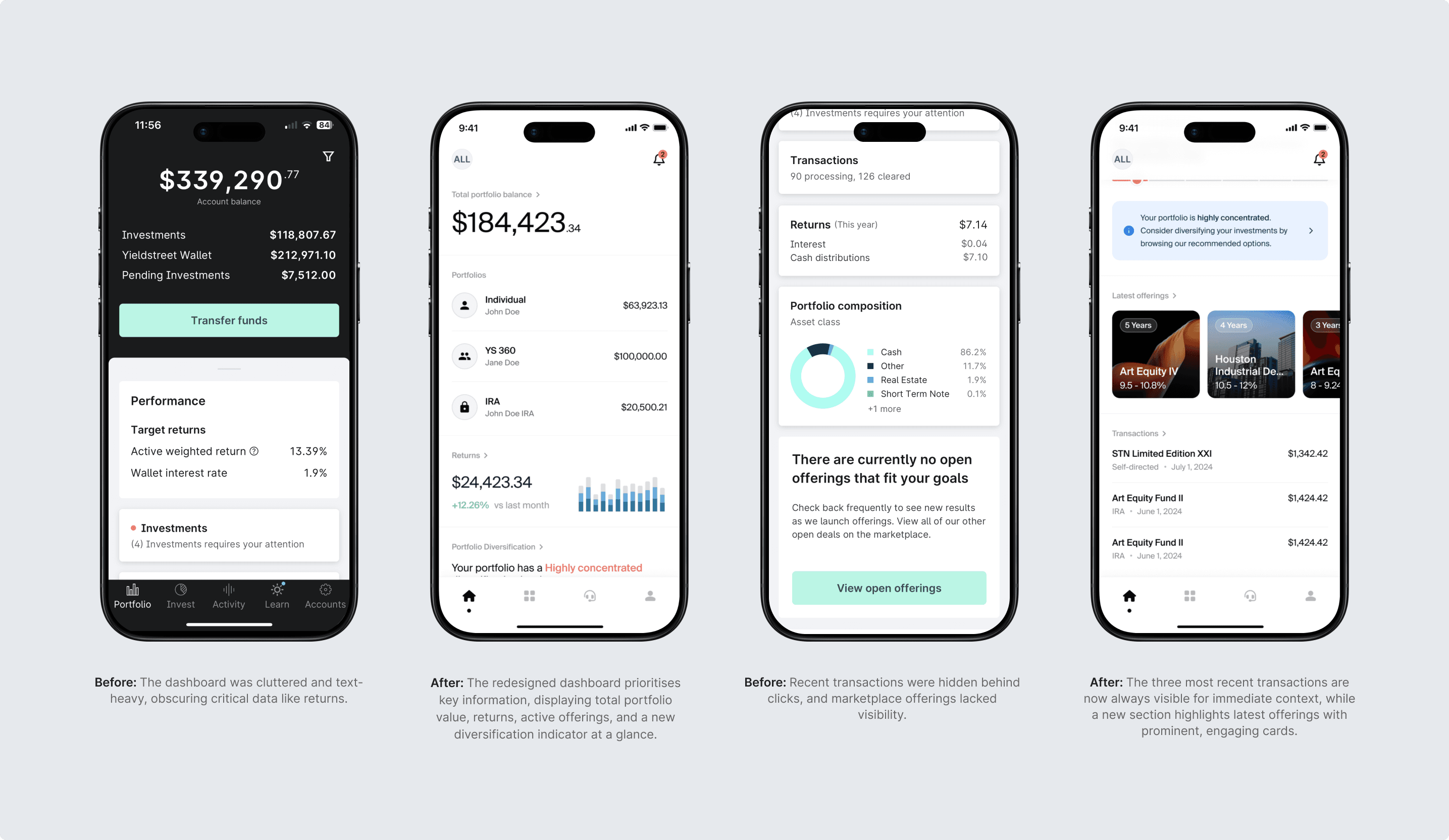
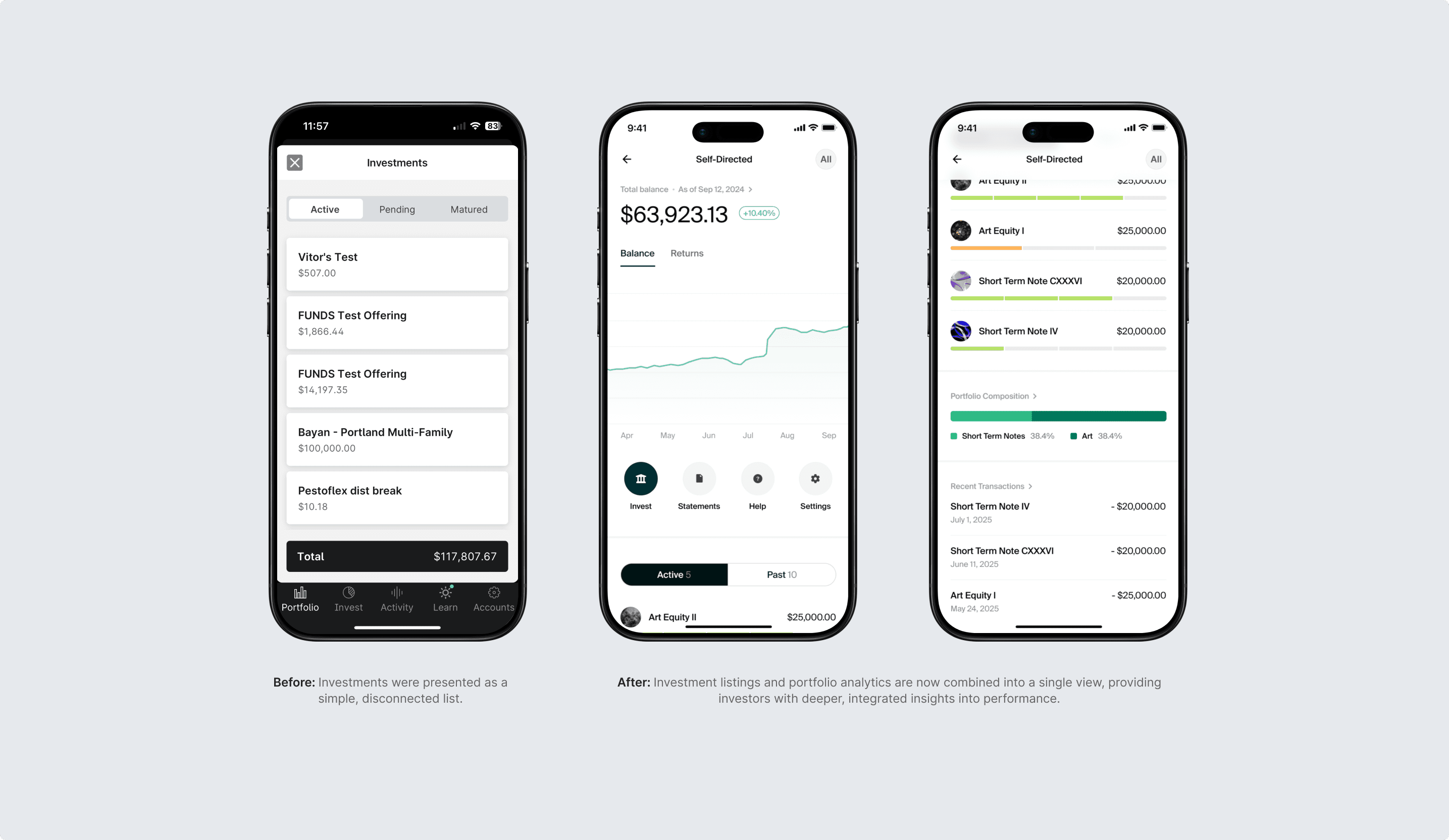
Research identified that users primarily open the app to check performance, yet the old design buried this data. The dashboard was redesigned to prioritise hierarchy and clarity, mirroring the trusted web experience.
Elevating Key Metrics: The information hierarchy was restructured to prioritise the most critical data. "Net Portfolio Value" and "Total Earnings" were moved to the top of the screen with increased typographic prominence, ensuring users can assess their standing instantly upon login.
Visualising Performance: To address the feedback that data wasn't "easily visible," dense text lists were replaced with clear, interactive charts. These visual components allow users to grasp their asset allocation and performance trends at a glance, mirroring the depth of the web experience but optimised for mobile consumption.
Unified Navigation: The navigation structure was simplified to match the web dashboard's logic, reducing the learning curve for users switching between devices and making it easier to drill down into specific investment details.
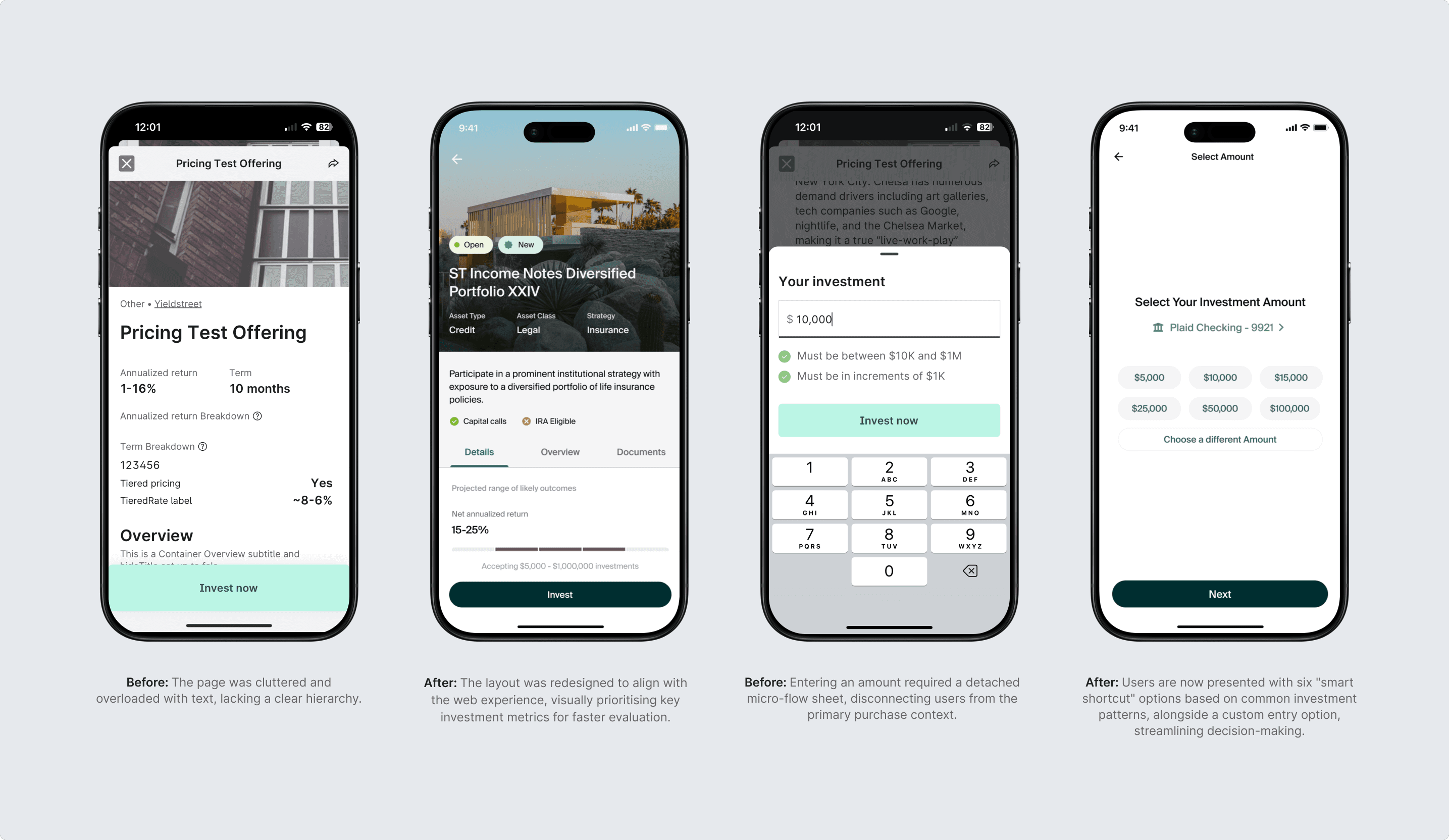
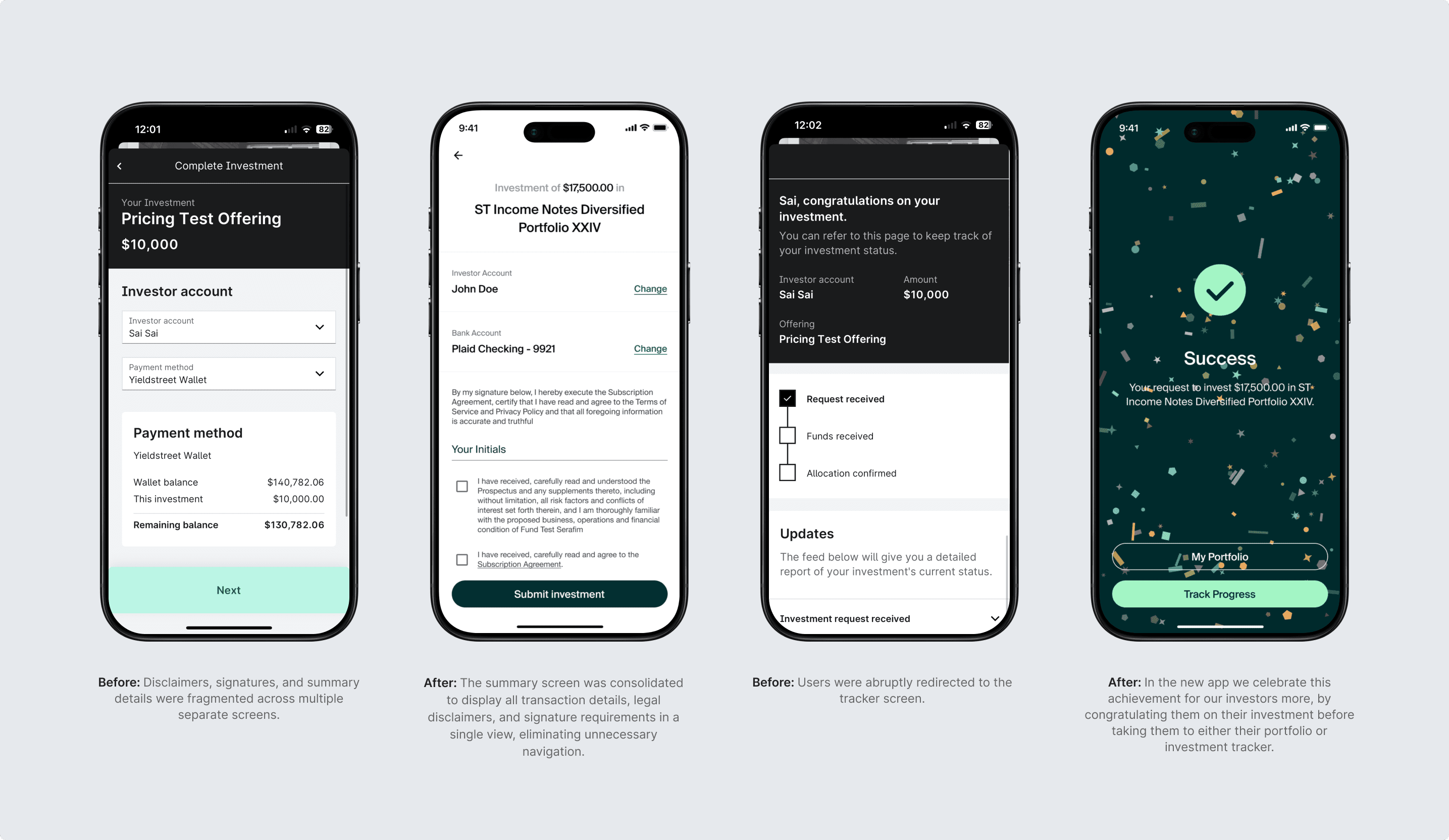
The investment funnel, the core revenue driver for the platform, was overhauled to reduce friction and match the decision-making mental models of investors.
Prioritising Offering Details: The offering page was redesigned to surface the metrics investors look for first. The key data points Net Annualised Return, Risk Rating, Term, Distribution Schedule, Exposure, and Capital Call Breakdown were moved to the top of the hierarchy. This prioritisation allows users to evaluate an opportunity immediately without unnecessary scrolling or hunting for data.
Frictionless Checkout: The checkout process underwent a massive reduction in complexity, shrinking from five steps (Complex, high drop-off) to just two (Streamlined, higher completion). By reorganising the information layout to reduce scrolling and optimising screen real estate, the interaction cost was drastically lowered, streamlining the path from decision to transaction.
These efficiency gains were the primary driver behind the 16% increase in mobile investment completion rate.
Balancing Speed vs. Scope
The tight project timeline necessitated a prioritisation strategy. The decision was made to focus the initial release on the highest-impact drivers: Onboarding, Portfolio Monitoring and Investment Execution. While this meant deferring full feature parity, the strong post-launch metrics validate that solving core friction points yields the highest immediate return.
The Path to Parity
With the foundation secured, the next phase of development focuses on bridging the remaining functional gaps between web and mobile. The roadmap prioritises adapting complex features such as Capital Calls, Account Management, and Managed Portfolio Setup for the mobile environment. Integrating these capabilities will complete the ecosystem, ensuring investors have full autonomy over their assets, regardless of the device they choose.