Payment Provider Migration
Migrating 20,000+ investors from Synapse to Plaid under a hard deadline, without losing trust.
When our KYC and payments provider Synapse was shut down, we had weeks to migrate over 20,000 active investors to a new provider without losing their trust.
Skills
User Research
Design Audit
Design System
Prototyping
Testing
My Role
Product Designer
Year
2024
Overview
Payments and KYC sit at the core of the Yieldstreet platform. Every investor account, every investment transaction, and every distribution payment ran through Synapse. When Synapse was shut down, we had a hard deadline to move the entire investor base to Plaid, a new provider, with no extension possible. This wasn't a redesign driven by user feedback. It was a high-stakes infrastructure migration where the design challenge was to protect investor trust and make the transition as invisible as possible.
Highlights
69%
Investor migration rate
93.7%
Investment migration rate
$3.37B
Assets migrated
The Challenge
Three problems that all needed solving at once
The migration involved three distinct user groups and a significant product change, all running in parallel. The wallet feature, which allowed investors to receive distributions and hold funds before reinvesting or withdrawing, was not supported by Plaid. Removing it while simultaneously migrating every account meant we had to handle both technical communication and product change communication at the same time.
The three problems we needed to solve
How do we migrate existing investors
Current investors needed to reactivate their accounts by completing KYC and linking a bank account through Plaid before they could make new investments.
How do we handle multiple account types
Some investors had a single account. Others had multiple, each requiring individual migration. The flows and messaging had to work for both without confusion.
How do we replace the wallet
With no wallet feature in Plaid, investors now needed a default bank account for receiving distributions. We had to communicate this change clearly and make the new setup frictionless.
Approach
Designing for trust first, friction second
Unlike a standard UX project, there was no blank canvas here. The scope was fixed: use what exists, deliver on time, and don't alarm investors. The design process focused on communication hierarchy and flow logic rather than visual exploration. The core question at every step was: does this give investors enough information to feel confident, and does it ask them to do as little as possible?
We mapped out the three user journeys separately before consolidating into a shared flow wherever logic allowed. New investors were the simplest case. Existing investors required more care, particularly around messaging, since they were being asked to take action on an account they had trusted for years.
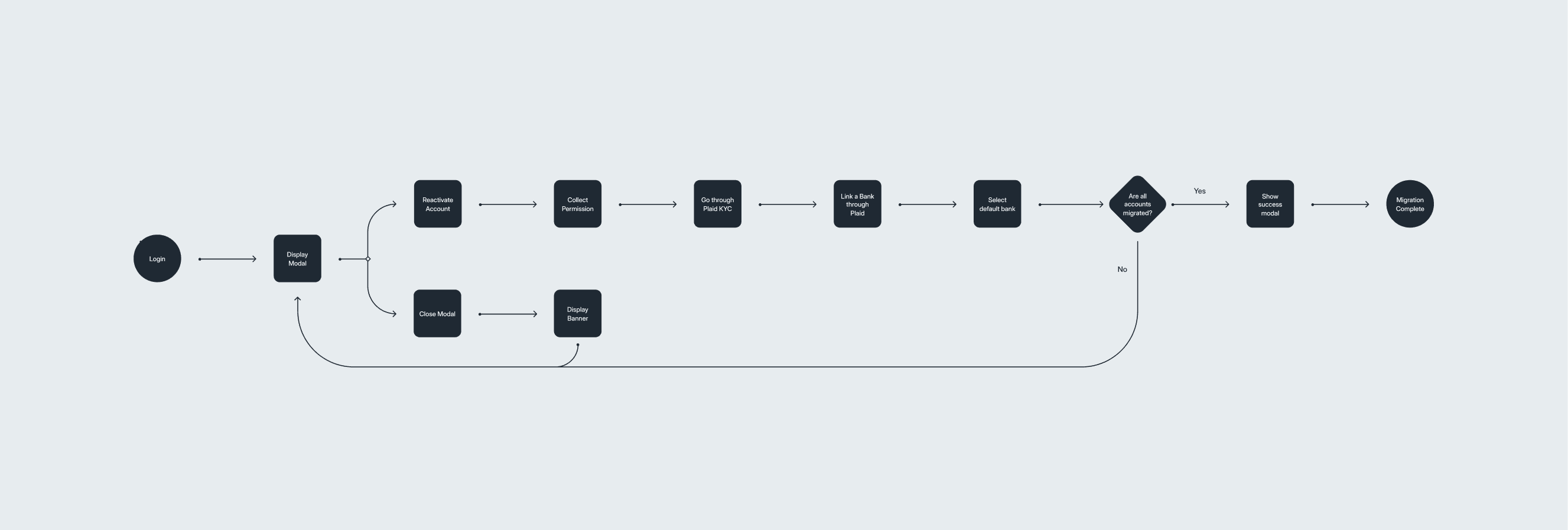
Solution
The final design covered three distinct experiences. Each one had different communication needs, but all shared the same underlying principle: tell investors exactly what is happening, why, and what they need to do.
New Investor Onboarding
New investors had no existing funds on the platform and no history with Synapse, so the communication challenge was minimal. The previous onboarding flow had separate KYC and bank linking steps through Synapse. These were replaced with a single consent screen that explained the data sharing arrangement with the new providers. After consenting, investors were redirected to Plaid to complete KYC and link a bank account before returning to the platform to start investing.
Existing Investor Migration
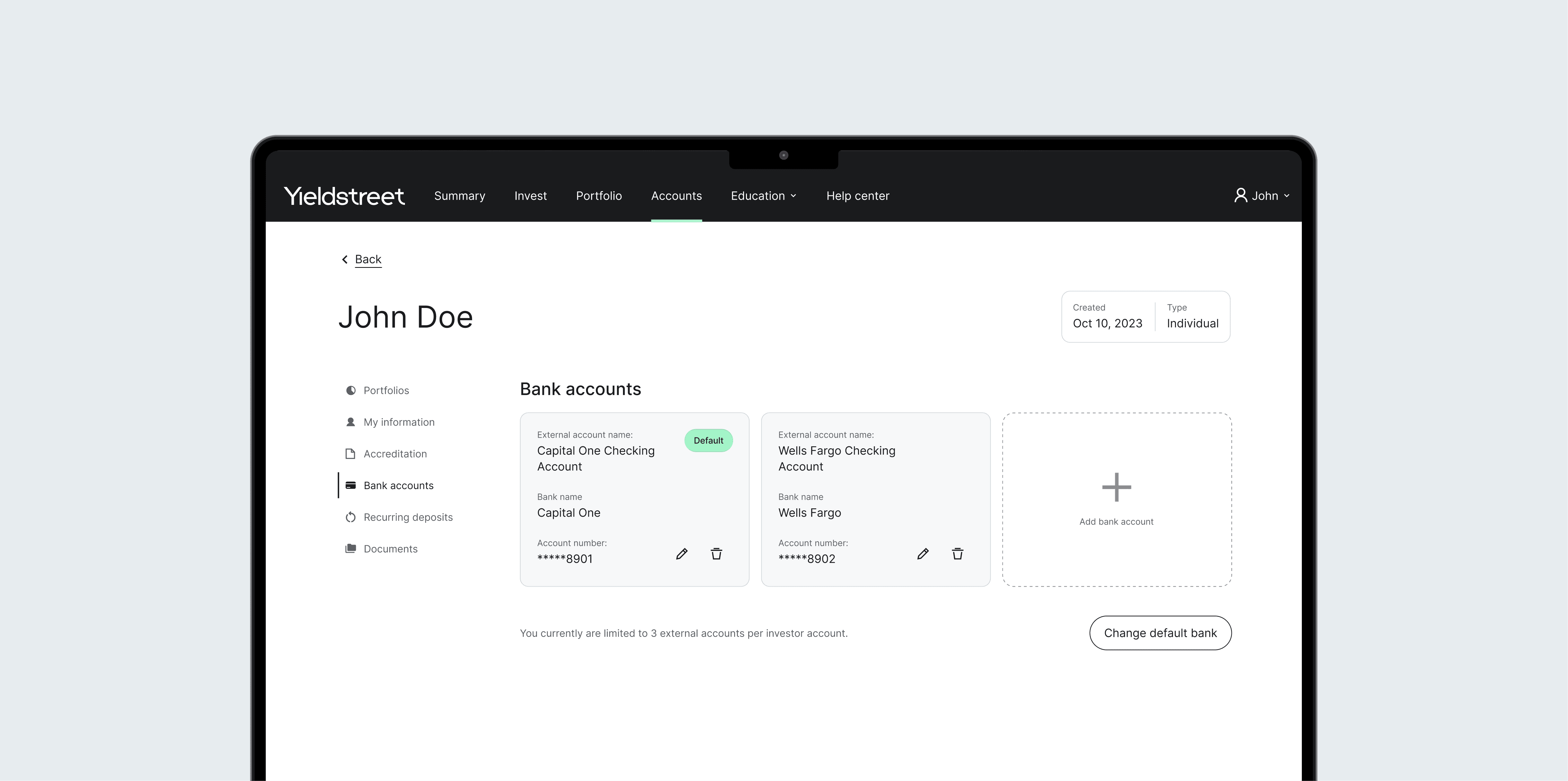
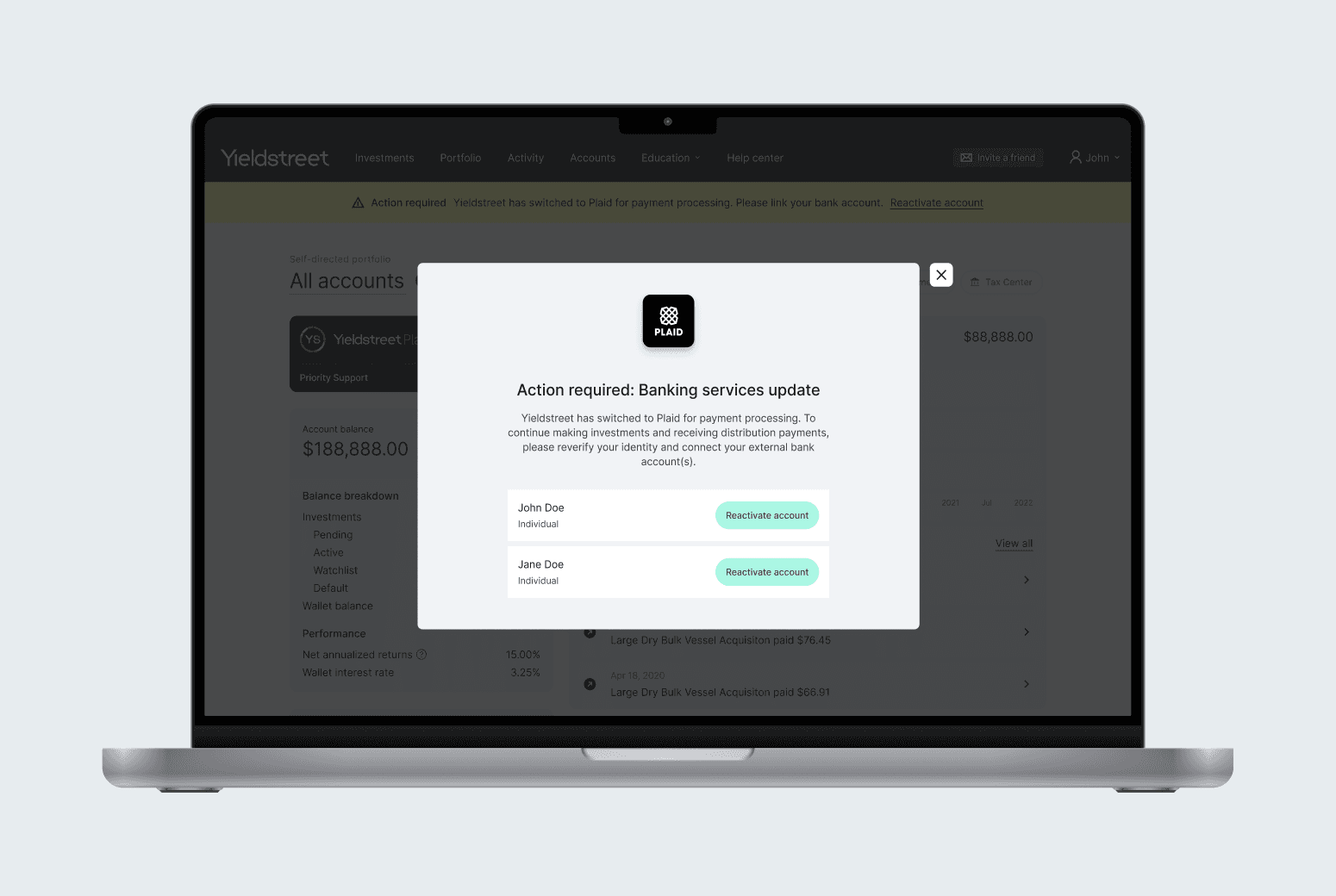
Existing investors were blocked from making new investments until they completed the migration. The migration trigger was a modal on login, so the first thing investors saw when they returned to the platform was a clear explanation of what had changed and what they needed to do. Single-account investors saw a straightforward message and a single migration path. Multi-account investors saw different messaging that made clear each account needed to be migrated individually, with guidance on the order and process for each account type.
Replacing the Wallet
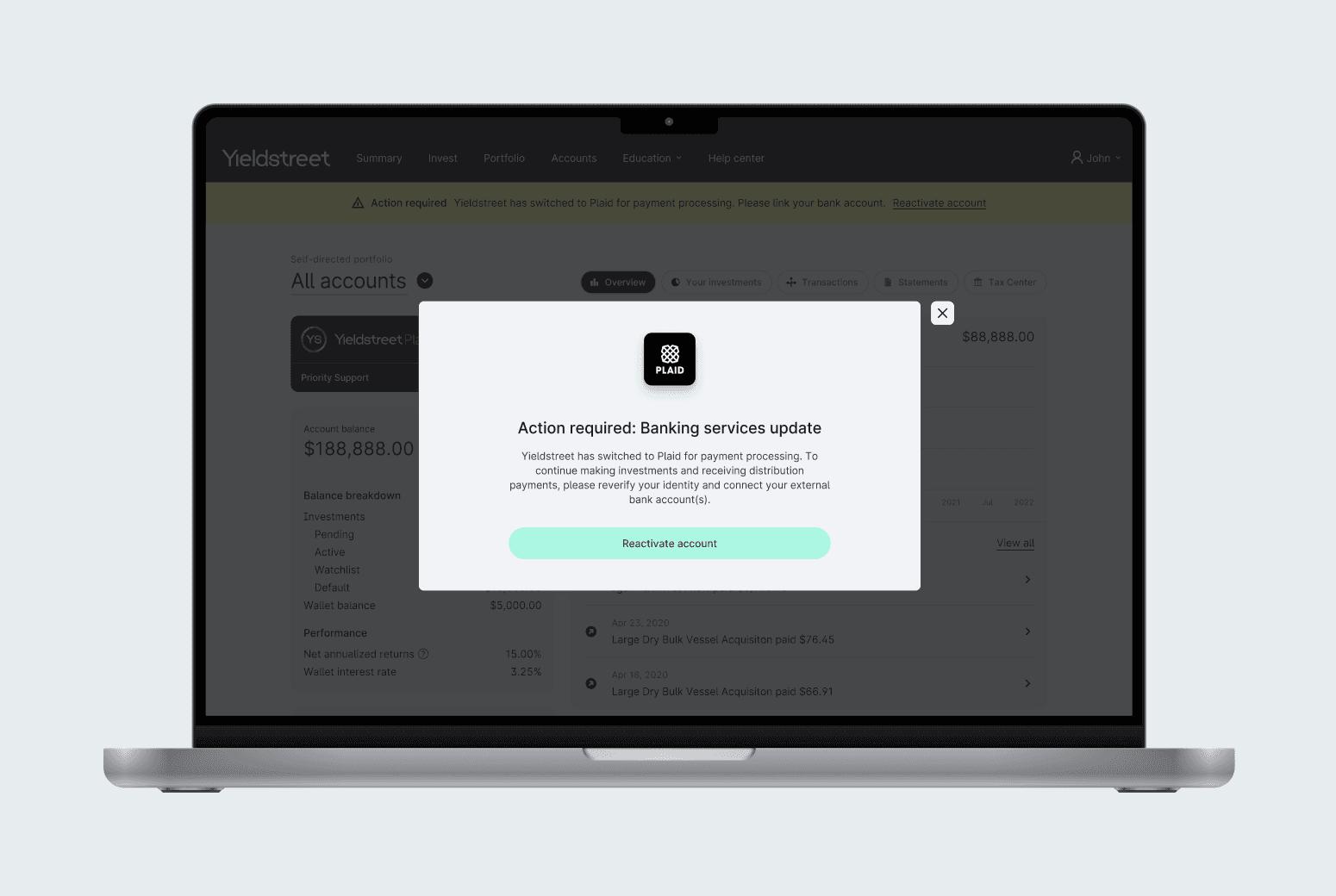
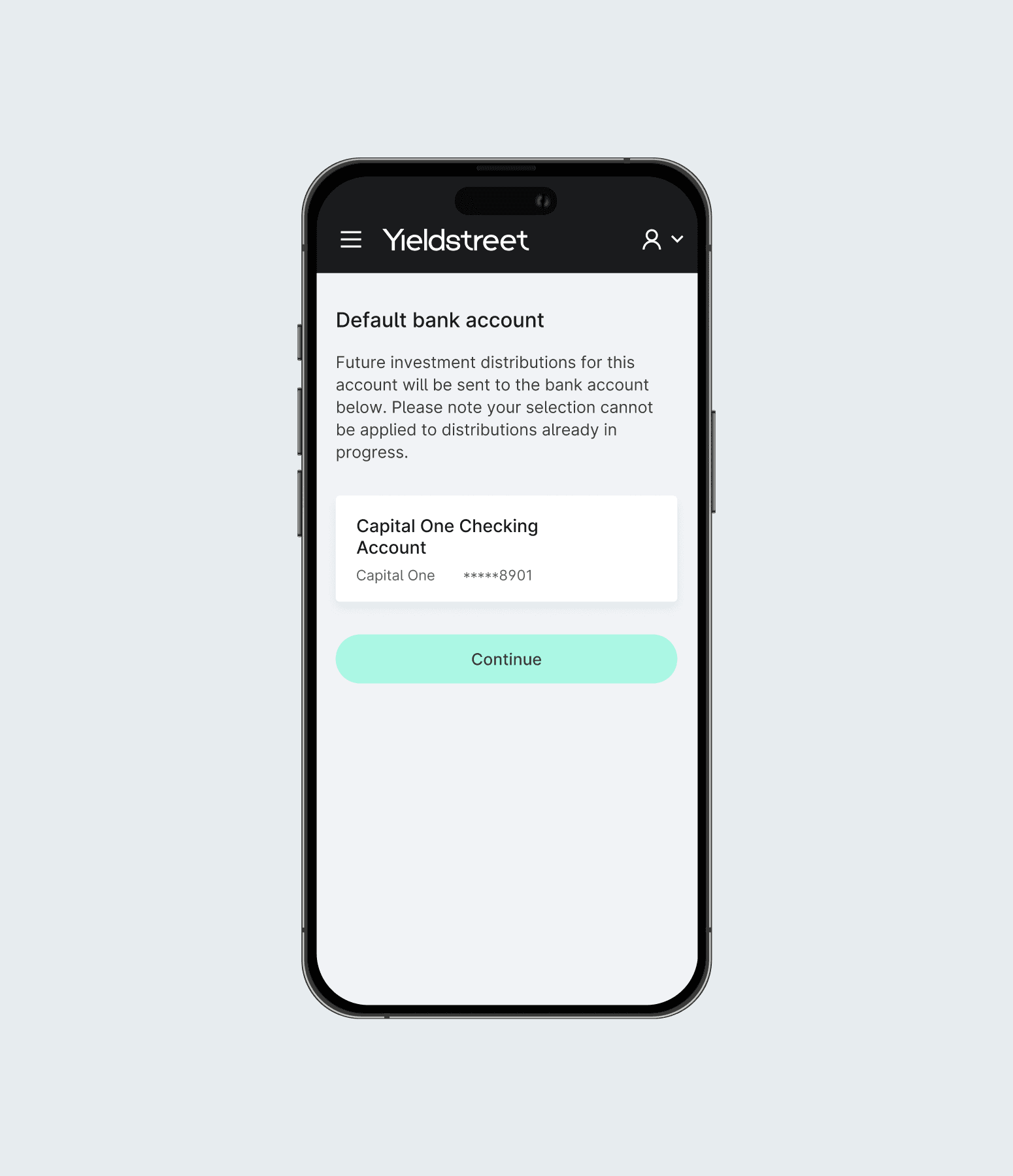
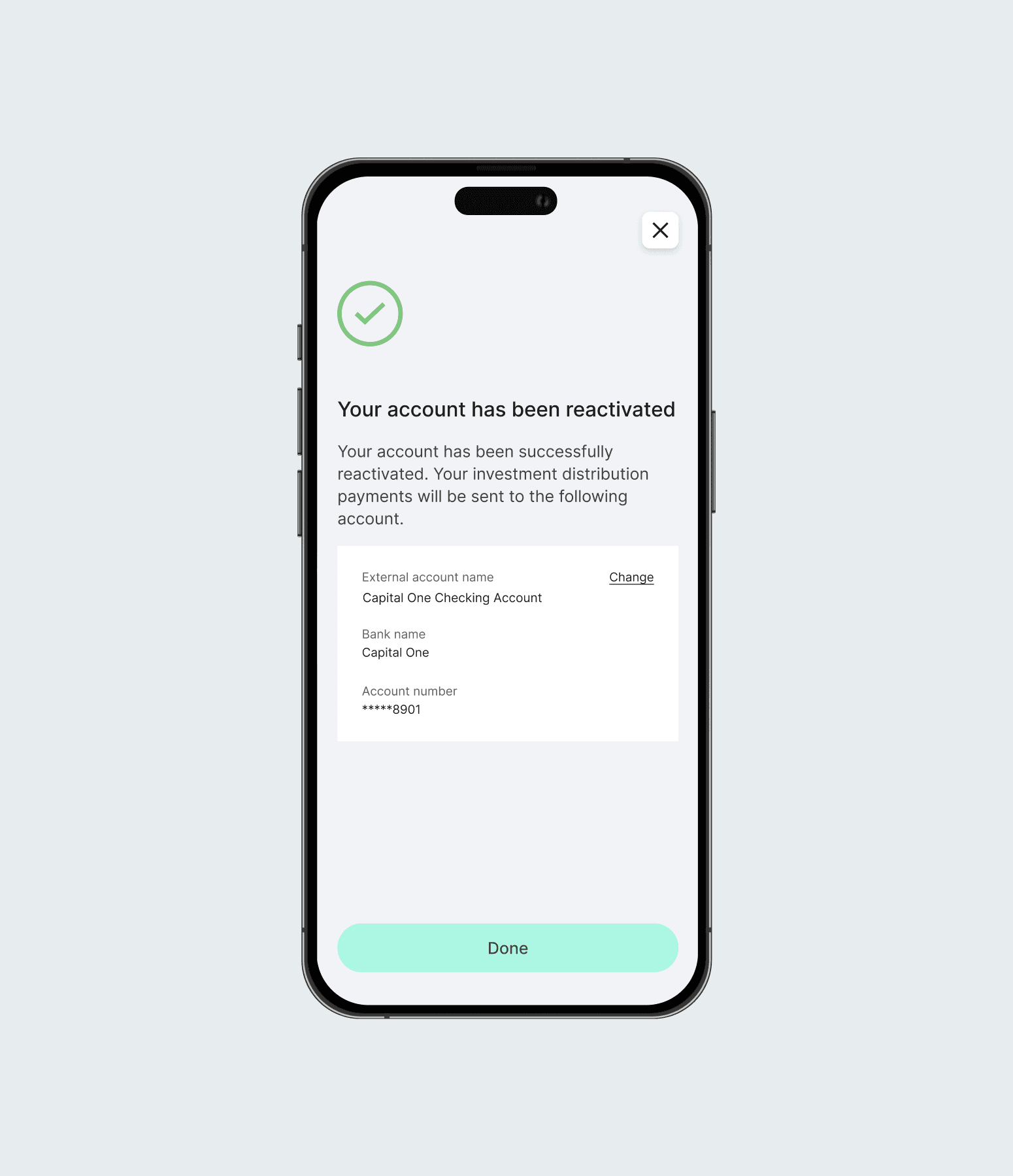
The wallet removal was the most sensitive communication challenge. Investors who held funds in their wallet needed to know what would happen to their money and what the new process would be. The replacement was a default bank account system: the first bank linked through Plaid was automatically set as the default for receiving distributions. Investors could link up to three accounts and designate any of them as the default. New UI elements were added to the bank account section, including a default tag and a change default bank option, to make the new system transparent and manageable.
Impact
Within one month, the platform had moved billions. The migration completed within the required deadline. Given that this was a forced, compulsory change to a financial platform, the results reflected the effectiveness of the communication and flow design in maintaining investor confidence throughout.
Highlights
69%
Investor migration rate
14,239 of 20,637 eligible investors migrated within the first month. For a compulsory action requiring investors to re-engage with their account, this reflects a smooth, trust-preserving experience.
93.7%
Investment migration rate
171,559 of 183,045 investments were migrated. The near-complete migration of investment data was the most critical outcome for the business and for investor confidence.
$3.37B
Assets migrated
Of $3.72 billion eligible, $3.37 billion was successfully moved across within the first month. The scale of what was transferred with no reported trust breakdown reflects the quality of the communication design.